Upwords
My mom and I have played Upwords for years. So I built it — and then I built two versions that don't exist on any board, including one where both players move at the same time and find out together whether they just helped or wrecked each other.
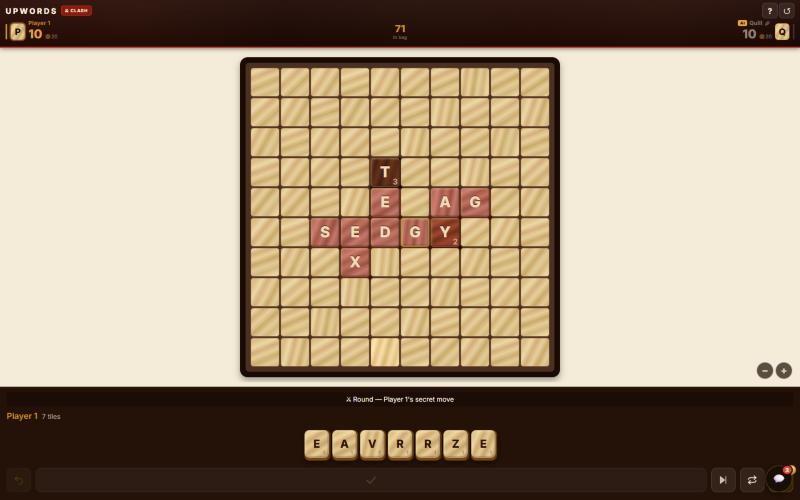
My mom and I have played Upwords for years. It's Scrabble's quieter cousin: a 10×10 board, and instead of only placing tiles beside each other you can stack them on top of each other, up to five high, as long as the new letter differs from the one underneath. Change one letter and the whole word becomes a different word. Every tile scores its stack height — so a word lying flat on the board is worth exactly one point, no matter how clever it is. The game pushes you upward.
I built a version we could play when we're not in the same room. Then I kept going.
Three ways to play, three sets of rules
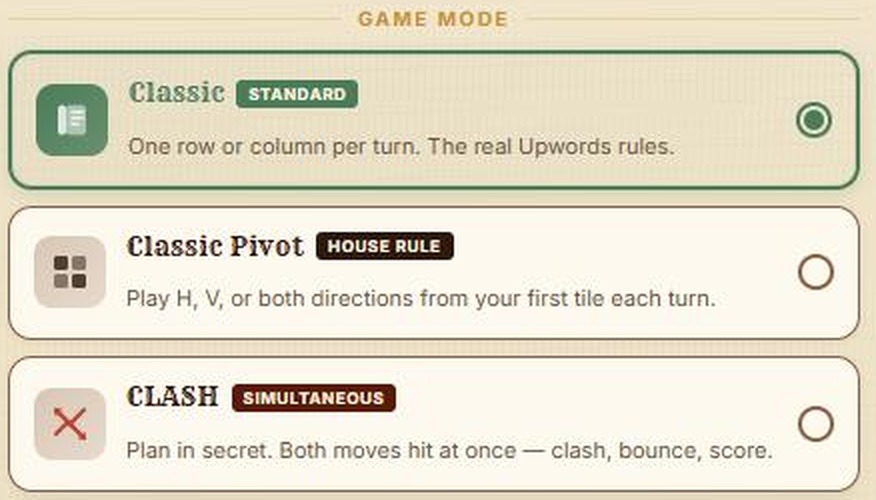
Classic is the real game, unchanged: one row or one column per turn.
Classic Pivot is a house rule. From your first tile each turn you can build horizontally, vertically, or both — so a single turn can turn a corner. It sounds like a small change. It isn't. The board opens up and suddenly you're planning an L instead of a line.
Clash is the one I'm proudest of. Both players plan in secret and both moves land at the same time.
What happens when two moves collide
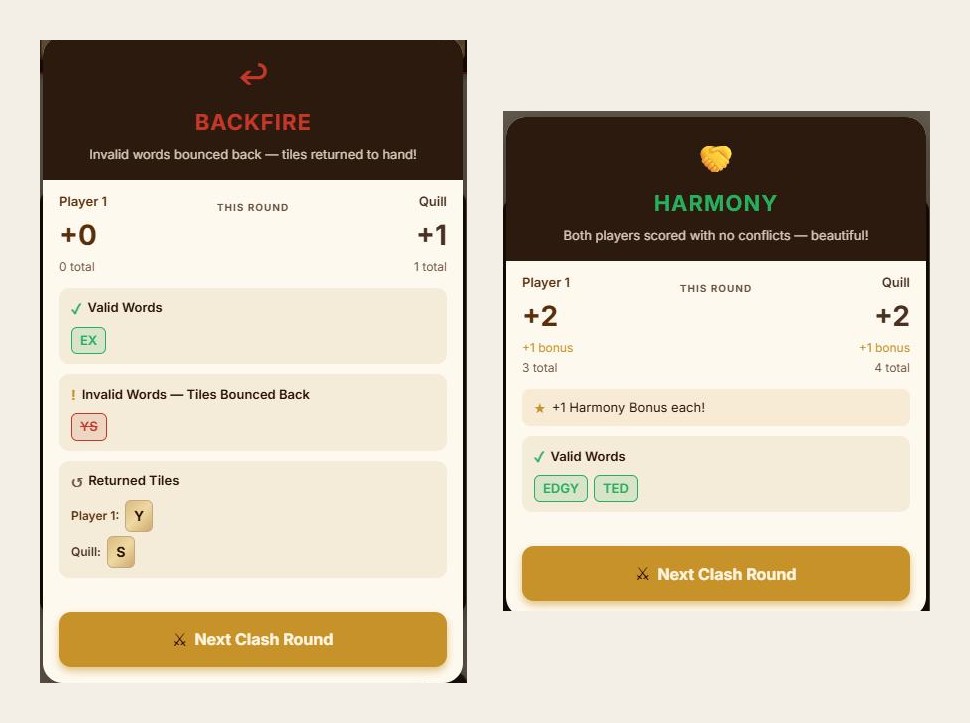
That simultaneity creates a situation no turn-based word game has. You can't see what your opponent is doing, so your beautiful word might land next to theirs and form something that isn't a word at all. When that happens the round backfires — the offending tiles bounce straight back to both hands and nobody scores them. The first round I played, I stacked a Y to make EDGY, my opponent played an X somewhere I couldn't see, the two of them met as "YS", and we both got nothing.
But if both moves land cleanly, it's harmony, and you each get a bonus point for it.
I didn't expect that to be the interesting part. You'd think simultaneous play would make the game purely adversarial — block them, trap them, poison the squares they want. Instead the bonus means you spend half your time trying to guess where your opponent is going so you can stay out of their way. It turned a word game into a game about reading another person. Which, when you're playing your mom, is about right.
The rest of it
Play pass-and-play on one device, against the computer, or online — sign in, send someone an invite, and take turns across days, which is the mode that actually gets used. There are three AI opponents with different temperaments, Quill, Stax and Bravo, at three difficulties. QU lives on a single tile. You can dump tiles back in the bag at the cost of your turn. The game ends when the bag is empty and somebody plays out.
It isn't bug free. If people play it, I'll fix it — so if something breaks, tell me.